Casa Brisas, Honestly Reviewed: Budget, Timeline and What We Learned in Playacar
Quick Answer
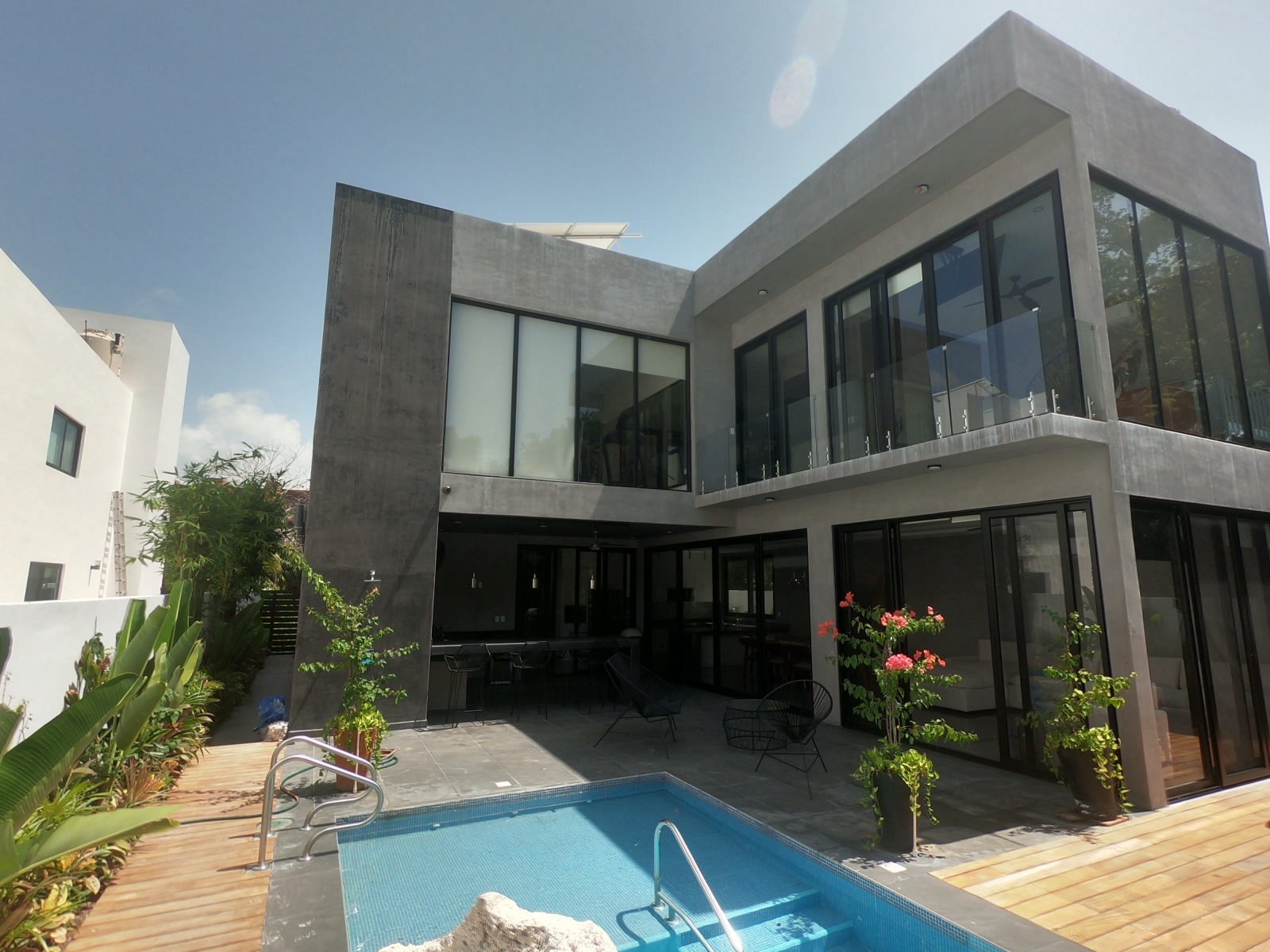
Casa Brisas is a ground-up custom home in Playacar Phase II, Playa del Carmen, designed and built by PlayaBuilder for an owner who lived outside Mexico for most of construction. It started with a US$595,000 budget for the original house. The owner then greatly expanded the project, adding a grotto, a much larger pool, a backyard, a jacuzzi and more square meters. A new budget of US$689,000, excluding land, was set for the expanded home, and the house was built on that budget in about one year. Our biggest lesson: some finishes the owner chose aren’t right for the Riviera Maya’s humidity, and we should have objected more strongly.
Most builders show a finished home at sunset and let the photo do the talking. A photo can’t tell you what the house was supposed to cost, what changed along the way, or what the builder would do differently.
This post is a review of one of our own projects, with the real numbers and an honest lesson. Casa Brisas is useful for two reasons. The owner lived outside Mexico for most of the build, which is the situation many of our clients are in. And the project grew a lot after it started, which is exactly when budgets usually go wrong.
The project at a glance
| Casa Brisas | |
|---|---|
| Location | Playacar Phase II, Playa del Carmen |
| Type | Ground-up custom home |
| Scope | Full design-build: design coordination, permitting, purchasing, supervision and handover |
| Original budget (original house) | US$595,000, excluding land |
| Added by the owner | Grotto, much larger pool, backyard, jacuzzi, more square meters |
| Revised budget (expanded home) | US$689,000, excluding land |
| Final cost | US$689,000, built on the revised budget |
| Documented change orders | 20, all approved by the owner |
| Timeline | About one year |
| Owner | Lived outside Mexico for most of the build |
You can see photos on the Casa Brisas project page.
Two budgets, because there were two houses
The question every buyer wants answered is: did it cost what they said it would? For Casa Brisas, the honest answer needs two numbers, because the house that was finished wasn’t the house that was first budgeted.
| Scope | Budget | |
|---|---|---|
| Original budget | The house as first designed | US$595,000 |
| Expansion added by the owner | Grotto, much larger pool, backyard, jacuzzi, more square meters | +US$94,000 |
| Revised budget | The expanded home | US$689,000 |
| Final cost | Built on the revised budget | US$689,000 |
At 449 m², that works out to about US$1,535 per m² (about US$143 per sq ft), including the grotto, larger pool and jacuzzi.
The original US$595,000 covered one house. During the project, the owner decided to make it a much bigger one, with a grotto, a far larger pool, a finished backyard, a jacuzzi and more living space. Those additions were priced, documented in 20 change orders and approved by the owner, and a new budget of US$689,000 was set for the expanded home. The house was then built on that new budget.
That’s the distinction buyers should look for in any builder’s numbers. A final cost higher than the first budget isn’t automatically an overrun. It’s an overrun when the same house costs more. When the owner asks for a bigger house, the honest result is a new budget agreed in advance, and a builder who then delivers on it.
How the timeline went
Casa Brisas took about one year from the start of construction to handover, including the expansion. For a custom home in Playa del Carmen, adding a grotto, a larger pool, outdoor living and extra square meters without a long delay is a solid result.
What helped:
- The core design was approved before construction, so the structure and systems weren’t waiting on decisions.
- Each addition was priced and approved before it was built, so the crew wasn’t stopped waiting for answers from an owner who was abroad.
- Purchasing was handled by the same team as part of the design-build scope, so orders followed approved selections.
Building in Playacar Phase II
Casa Brisas sits in Playacar Phase II, the golf-course section of one of Playa del Carmen’s most established gated communities. We cover the area in depth on our Playa del Carmen and Playacar page.
HOA design review. Playacar Phase I and Phase II each have their own architectural review and HOA approval, which must be coordinated with the municipal permit. Additions such as a larger pool or a grotto may also need to fit the HOA’s standards.
Firmer ground than the beachfront. Phase II’s ground is firmer and more predictable than Phase I’s sandy, high-water-table beachfront soil. PlayaBuilder estimates Phase I lots typically need 25–35% more foundation cost and 3–4 months longer to build (Playacar Phase I vs. Phase II). In Phase II, permitting focuses more on golf-course sightlines than on soil engineering.
Why Playacar costs more overall. HOA-enforced design standards and larger average lot sizes add cost across Playacar (why Playacar costs more to build). The premium reflects real requirements, not inflated pricing.
What we’d do differently
The owner asked for some finishes that simply weren’t right for this climate. He was really into them, and we went along. We should have objected more strongly.
The Riviera Maya’s humidity is hard on materials that perform well in drier climates. Some finishes absorb moisture, stain, swell or lose their surface over time when they’re constantly exposed to humid air. Building scientists point out that in hot-humid climates, humid outdoor air reaching cool, air-conditioned surfaces is the main moisture risk, which is why material choice matters as much as the structure (Building Science Corporation, BSD-012).
It’s the owner’s home, and the final choice is always theirs. But our job is to make sure that choice is fully informed, not just mentioned once. What we do now:
- Put the concern in writing, so the owner sees clearly which finishes are likely to struggle in humidity and why.
- Show the alternative side by side with a physical sample, so the owner compares real materials, not descriptions.
- Explain the long-term cost: what maintenance or replacement the finish is likely to need over the first few years.
If the owner still chooses the finish after that, we document the decision and build it well. What we won’t do again is let a strong preference go unchallenged because the client was excited about it.
Building from abroad: how it actually worked
The owner of Casa Brisas lived outside Mexico for most of construction and wasn’t on site day to day. That made the expansion harder to manage, not easier. Here’s how it worked:
- The core design was approved before construction.
- Each addition was priced before it was approved: the grotto, the larger pool, the backyard, the jacuzzi and the added square meters, documented across 20 change orders.
- A new budget was set for the expanded home, so the owner always knew the target.
- The budget was tracked against that figure through to handover.
- Remote-owner reporting, which is standard on PlayaBuilder projects, let the owner follow the build without flying down.
We explain this approach in our guide to managing a project when you live abroad.
What Casa Brisas does and doesn’t prove
What it shows: a custom home in Playacar can grow substantially during construction and still finish on a clearly agreed budget, in about a year, for an owner who isn’t in Mexico.
What it shows about budgets: a budget is a promise about a specific scope. When the scope grows, the right response is a new budget, agreed before the work, not a surprise at the end.
What it doesn’t show: that your home will cost the same. Your lot, size, finish level and decisions will set your number. PlayaBuilder’s current range for new custom homes is 22,000–35,000 MXN per m² (about US$111–177 per sq ft), before land. Pools, grottos and landscaping are priced separately.
What it can’t show yet: how the home performs after many years of hurricane seasons. With any builder, ask to see homes that are several years old, not just new ones.
A realistic comparison: two ways a project can grow
This is a composite pattern drawn from the kinds of projects we see in Playacar, not a description of the Casa Brisas owner.
Two owners each decide mid-build to add a bigger pool and more outdoor living space. The first builder prices the additions, sets a new budget and gets it approved before starting the work. The second builder says “we’ll sort it out at the end.”
Both owners get the pool they wanted. The first knows the final number months in advance. The second finds out at handover, and the relationship sours over an invoice nobody agreed to. The additions were the same; the outcome depended entirely on how the change was managed.
The insight from this project
An expanded project isn’t a blown budget, as long as the new budget is agreed before the new work begins. Casa Brisas started as a US$595,000 house and became a US$689,000 home with a grotto, a much larger pool, a backyard and a jacuzzi. The number grew because the house grew, and the owner knew the new number before the work started.
The best-in-class check
If you could verify only one thing about any builder’s past project, ask to see the original budget, the scope changes and the final cost side by side. A builder who can show you that comparison, and explain why the number moved, is a builder who tracks it.
Fact Box: Casa Brisas
- Location: Playacar Phase II, Playa del Carmen
- Type: ground-up custom home, full design-build by PlayaBuilder
- Size: 449 m² (about 4,833 sq ft)
- Original budget: US$595,000 for the original house, excluding land
- Expansion: grotto, much larger pool, backyard, jacuzzi, more square meters (20 documented change orders)
- Revised budget and final cost: US$689,000, excluding land, built on the revised budget
- Timeline: about one year
- Owner: lived outside Mexico for most of the build
- Lesson: object more strongly to finishes that don’t suit the Riviera Maya’s humidity
Quick answers
How much did Casa Brisas in Playacar cost to build? Casa Brisas, a ground-up custom home in Playacar Phase II built by PlayaBuilder, started with a US$595,000 budget. After the owner added a grotto, a much larger pool, a backyard, a jacuzzi and more square meters, a new budget of US$689,000 excluding land was set, and the home was built on that budget in about one year.
What happens to the budget when you expand a custom home during construction in Mexico? On Casa Brisas in Playacar, PlayaBuilder priced each addition, documented them in 20 change orders and set a new budget of US$689,000 before the work, up from the original US$595,000. The house was then built on the revised budget.
Can you build a home in Playa del Carmen while living abroad? Yes. The owner of Casa Brisas in Playacar lived outside Mexico for most of construction, approved every addition remotely, and received a revised budget before the expanded work began.
What finishes should you avoid in the Riviera Maya? Finishes that perform well in dry climates can struggle in the Riviera Maya’s constant humidity, absorbing moisture, staining or swelling over time. Compare samples side by side and ask your builder, in writing, how each finish will hold up.
Decision Framework
1. What type of owner are you?
- Foreign buyer building a vacation home: decide on pools, outdoor living and size before construction if you can; if you add them later, ask for a revised budget first.
- Expat relocating permanently: you can be more involved on site, but save additions for scheduled reviews.
- Investor building to rent: price additions such as pools and jacuzzis against the rental income they’ll bring.
- Developer: treat this as a single-home benchmark; multi-unit projects need their own planning.
- Owner remodeling in Playacar: expect HOA review for pools, grottos and other exterior additions.
2. What is your primary concern?
| If your main concern is… | What Casa Brisas suggests |
|---|---|
| Knowing the final cost | Get a revised budget approved before any addition starts |
| Staying close to the first number | Decide on size, pool and outdoor spaces before construction |
| Timeline | Approve the core design first; price additions quickly |
| Long-term durability | Choose finishes suited to humidity, even if you love another |
| Managing from abroad | Written approvals and regular reporting |
3. What should you ask a builder about their past projects?
- What was the original budget, what changed, and what was the final cost?
- When the scope grew, was a new budget agreed before the work?
- What would you do differently on that project?
- Can I speak with the owner?
- Can I see a home you built several years ago?
4. What should you avoid?
- Adding a pool, a grotto or extra space without a revised budget in writing
- Comparing a final cost to an original budget without comparing the scope
- Choosing finishes for looks alone in a humid climate
- Judging a builder only by photos of new homes
Follow-up questions this article answers
- What does it cost to build a custom home in Playa del Carmen? Casa Brisas cost US$689,000 excluding land, after expansion; PlayaBuilder’s current range is 22,000 – 35,000 MXN per m² (about US$111 – 177 per sq ft).
- How long does construction take in the Riviera Maya? Casa Brisas took about one year, including its expansion.
- What are the hidden costs of building a house in Mexico? Additions made during construction, such as pools and outdoor spaces, are among the biggest. Ask for a revised budget before approving them.
- How do I manage a project in Mexico if I live abroad? Approve the design early, get every addition priced in writing and agree a revised budget before new work begins.
- What is the best construction company in Playa del Carmen? One that will show you original budgets, scope changes and final costs for real projects.
Sources
| Claim in this article | Source |
|---|---|
| Original budget US$595,000; expansion (grotto, larger pool, backyard, jacuzzi, more square meters); revised budget and final cost US$689,000; 20 change orders; Phase II | PlayaBuilder leadership, October 2026 |
| Ground-up design-build, about one year, owner abroad | PlayaBuilder Casa Brisas project page |
| Expansion value +US$94,000 | Arithmetic: US$689,000 − US$595,000 |
| Finish objections lesson | PlayaBuilder leadership, October 2026 |
| Separate HOA review for each Playacar phase | PlayaBuilder Playa del Carmen & Playacar page |
| Phase I foundations 25–35% more and 3–4 months longer; Phase II permitting focuses on sightlines | PlayaBuilder Phase I vs. Phase II post |
| Reasons Playacar costs more | PlayaBuilder Playacar cost post |
| Humid air on cool surfaces drives moisture damage in hot-humid climates | Building Science Corporation, BSD-012 |
| 22,000 – 35,000 MXN per m² (about US$111 – 177 per sq ft) | PlayaBuilder current pricing; ~18.4 MXN/USD, which changes constantly |
Conclusion
Casa Brisas began as a US$595,000 house in Playacar Phase II. During construction, its owner turned it into something much bigger, with a grotto, a much larger pool, a backyard, a jacuzzi and more living space. A new budget of US$689,000, excluding land, was agreed for the expanded home, and the house was built on that budget in about a year, for an owner who lived outside Mexico.
We’re sharing the full story because it’s more useful than a single number. It shows that a project can grow and still finish on a clear, agreed budget when every addition is priced before it’s built. It also shows where we fell short: we should have pushed back harder on finishes that don’t suit the climate. If you’re building in Playa del Carmen, Cancún or Tulum, decide as much as you can before construction, get a revised budget before anything is added, and ask every builder to show you their own before-and-after numbers.
FAQ
Where is Casa Brisas? In Playacar Phase II, the golf-course section of the gated community at the south end of Playa del Carmen.
How much did Casa Brisas cost? US$689,000 excluding land, for the expanded home. The original house was budgeted at US$595,000.
Why did the cost go up? The owner added a grotto, a much larger pool, a backyard, a jacuzzi and more square meters. A new budget was set for the expanded home before that work, and the house was built on it.
Did Casa Brisas go over budget? No. It was built on the revised budget of US$689,000, which was agreed after the owner expanded the scope.
How long did it take to build? About one year, including the expansion.
Was the owner in Mexico during construction? No. The owner lived outside Mexico for most of the build and approved every addition remotely.
What would PlayaBuilder do differently? Object more strongly to finishes that aren’t suited to the Riviera Maya’s humidity, in writing and with side-by-side samples.
About the author
Jennifer Anderson is an architect with PlayaBuilder. She came to Playa del Carmen after stints in both Mexico and the United States. Her love of design has been with her since she was a young girl, and today she designs and writes about building and remodeling homes in Playa del Carmen, Cancún, Tulum and across the Riviera Maya.